
The Math That Should Terrify Every Western Entrepreneur
Hard data on why the Western fiscal model is breaking — and what builders can do about it.

In 1949, the British pound was devalued 30% overnight. The pound. The world’s reserve currency for over a century. One evening you went to bed in the most powerful empire on earth. The next morning, your savings bought a third less.
Nobody saw it coming. Or rather, everyone saw it coming and nobody believed it would actually happen. Britain had won the war, after all. They had the institutions, the credibility, the history. What they also had was debt exceeding 270% of GDP, an empire they could no longer afford, and a political class that had spent two decades pretending the math would sort itself out.

It didn’t sort itself out. Within three decades, Britain went from ruling a quarter of the globe to needing an IMF bailout.
I think about that story a lot. Because I look at the United States today, and Canada, and the UK, and France, and Germany, and I see the same pattern playing out in real time.
A little about me: I’m Nate. I grew up in Toronto. Did investment banking at Macquarie. Co-founded and took a company public on the TSX. Did my MBA at Yale. Checked the boxes.
And then I left. Quit my job. Moved to Panama. Nomad’ed around the world (over 70 countries), asking a question that most people in the Western professional class won’t let themselves ask: What if the default path is a trap?
I’ve now lived in nine countries and spent the last eight years based in Panama City, where I run Grey River Associates, a cross-border tax advisory firm that helps entrepreneurs with global structuring, strategic residencies, and asset protection. I hold a CFA, ADIT, and STEP designation and I’m pursuing an LLM in International Tax Law at King’s College London.
I’m not theorizing from an armchair. I’ve built my life and my business around a thesis: the Western fiscal model is breaking. The entrepreneurs who see it early can position themselves accordingly.
This is the inaugural issue of The Sovereign Entrepreneur. It lays out the evidence. Hard data. No hand-waving. And a question you’ll need to answer for yourself by the end.
The billionaires aren’t whispering anymore
Let’s start with something that should unsettle you.
Jamie Dimon wrote in his April 2025 JPMorgan shareholder letter that the U.S. government has been “fiscally irresponsible and profligate.”
This is the CEO of the largest bank in America. Not some podcast libertarian. Not a gold bug. The guy who sits across the table from the Treasury Secretary.
He estimated over $200 billion in annual “improper payments” alone, and listed “ineffective and incompetent government” and “crippling litigation, bureaucracy and regulation” among the grievances driving real anger in the country. In a CNBC interview a few months earlier, he was blunter: the government is “inefficient, not very competent, and needs a lot of work.”
Ray Dalio, founder of Bridgewater, put the math plainly on NPR last October: the U.S. government spends $7 trillion and takes in $5 trillion. Forty percent more than it earns, “selling into a world that does not really want to buy the amount of debt anymore.”
In January of this year, he said his grandchildren “not yet born are going to be paying off this debt in devalued dollars.” His March 2026 Fortune essay compared our era not to the postwar boom most of us grew up assuming was permanent, but to the period before 1945. The era of wars, currency crises, and empire collapse.
Larry Fink runs BlackRock. Ten trillion dollars in assets under management. His 2025 annual letter warned that by 2030, mandatory government spending plus debt service will consume all federal revenue. Every penny. He called it “a permanent deficit.”
Stanley Druckenmiller calls the trajectory “unheard of” and estimates total unfunded liabilities at $200 trillion. Warren Buffett told his shareholders the deficit is “unsustainable.” Paul Tudor Jones was the most direct: “All roads lead to inflation. That’s historically the way every civilization has gotten out.”
These aren’t fringe voices. These are the people who run the financial system. And they’re telling you, on the record, that it’s breaking.
Where the money actually goes - primarily not education, infrastructure or “social good”
Here’s what the U.S. federal budget looks like when you strip away the euphemisms.
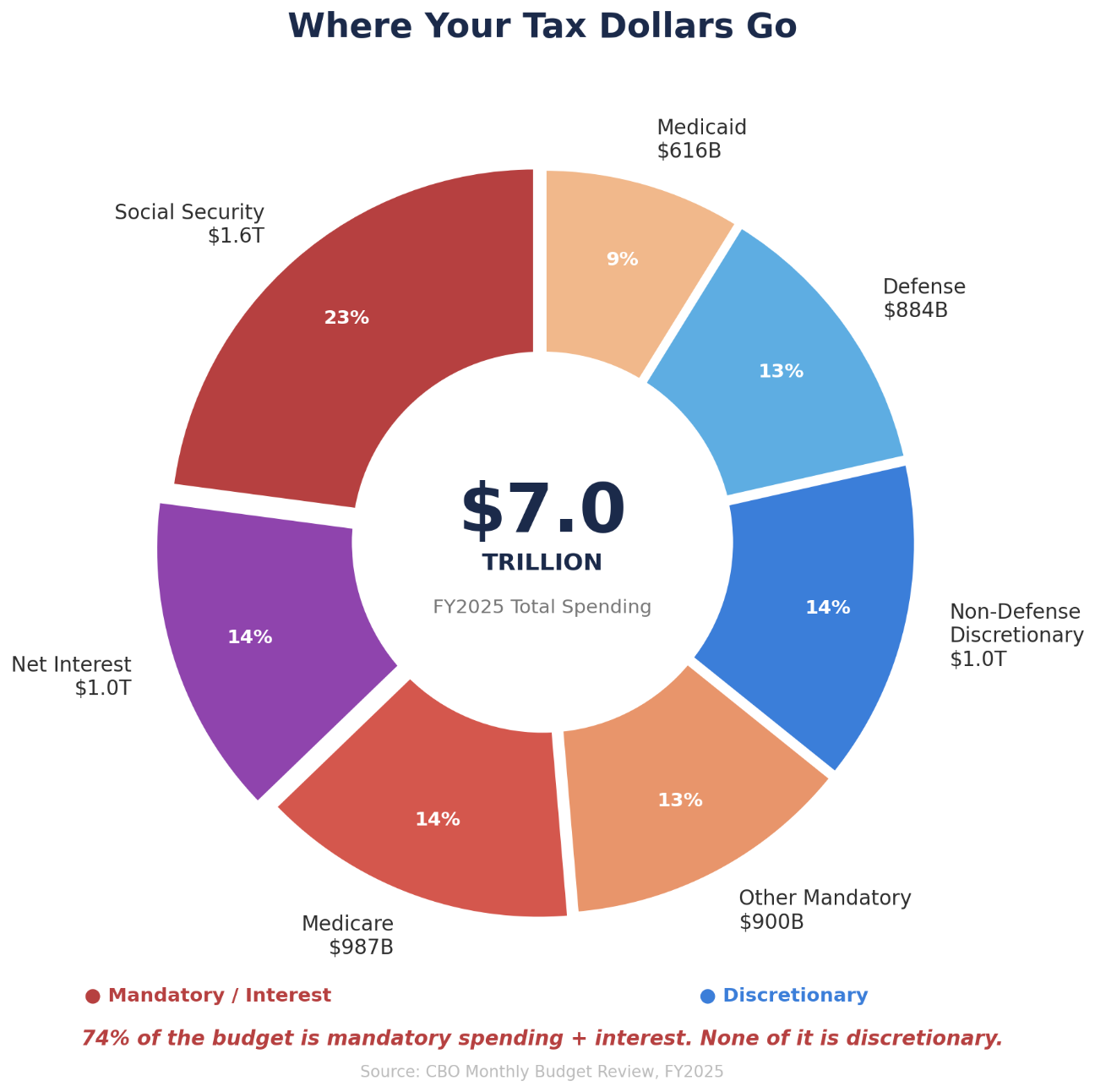
In FY2025, the government spent $7.0 trillion and collected $5.2 trillion, borrowing the $1.775 trillion difference. Interest on the national debt alone crossed $1 trillion for the first time in history. That’s more than the entire defense budget. More than Medicare. It has nearly tripled in five years.
Mandatory spending consumed 74% of the entire federal budget before a single road was paved or bridge was built. Social Security: $1.6 trillion. Medicare: $987 billion. Medicaid: $616 billion. Net interest: $1 trillion. The Bipartisan Policy Center noted that mandatory spending and interest roughly equaled total revenues. In other words, every dollar of discretionary spending was borrowed.
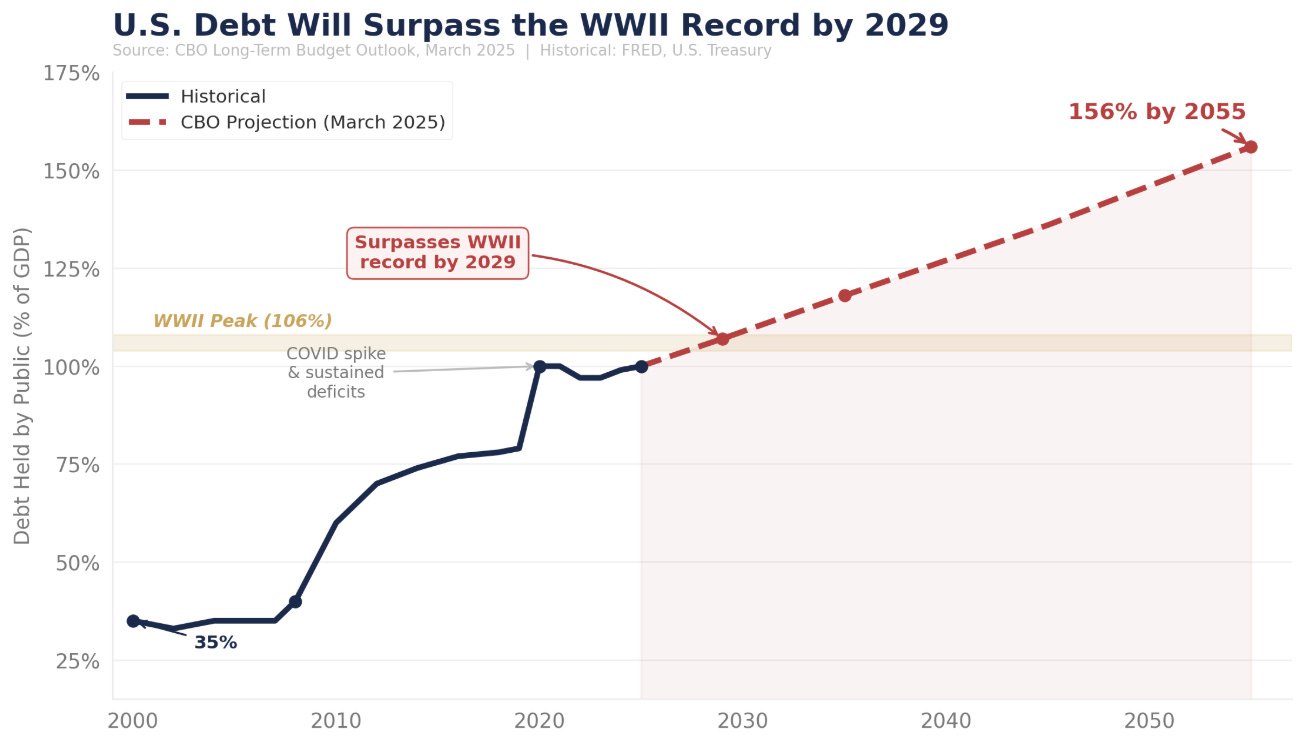
The national debt stands at roughly $39 trillion as of March 2026. Growing at $7.2 billion per day. It has more than quadrupled in 20 years.
The CBO projects debt will surpass the World War II record by 2029, reaching 156% of GDP by 2055. Total unfunded social insurance obligations jumped to $88.4 trillion last year, an increase of $10.1 trillion in a single year. Social Security’s trust fund depletes in 2033. After that, it pays 77 cents on the dollar.
This isn’t a political argument. I don’t care which party you vote for. This is arithmetic. And the arithmetic doesn’t negotiate.
The US healthcare system is totally ineffective and bankrupting the country
America spends $14,885 per capita on healthcare. Nearly double what comparable countries spend. It consumes 17.2% of GDP.
And what does it get for this? The lowest life expectancy among all comparable wealthy nations. Infant mortality 46% above the OECD average. Maternal mortality more than triple most peer countries. The Commonwealth Fund ranked the U.S. dead last out of ten wealthy nations in overall health system performance.
The money doesn’t go to health. It goes to administration. The U.S. spends $925 per capita on healthcare bureaucracy versus $245 for comparable countries. Nearly four times more. A comprehensive U.S.–Canada comparison found administrative costs consumed 34% of total U.S. health expenditures versus 17% in Canada.
One in three healthcare dollars goes to paperwork. Not doctors. Not treatments. Paperwork.
This matters for entrepreneurs because these bloated systems are what your tax dollars fund. And it’s why the bill keeps growing.
The 50% tax wall across the West
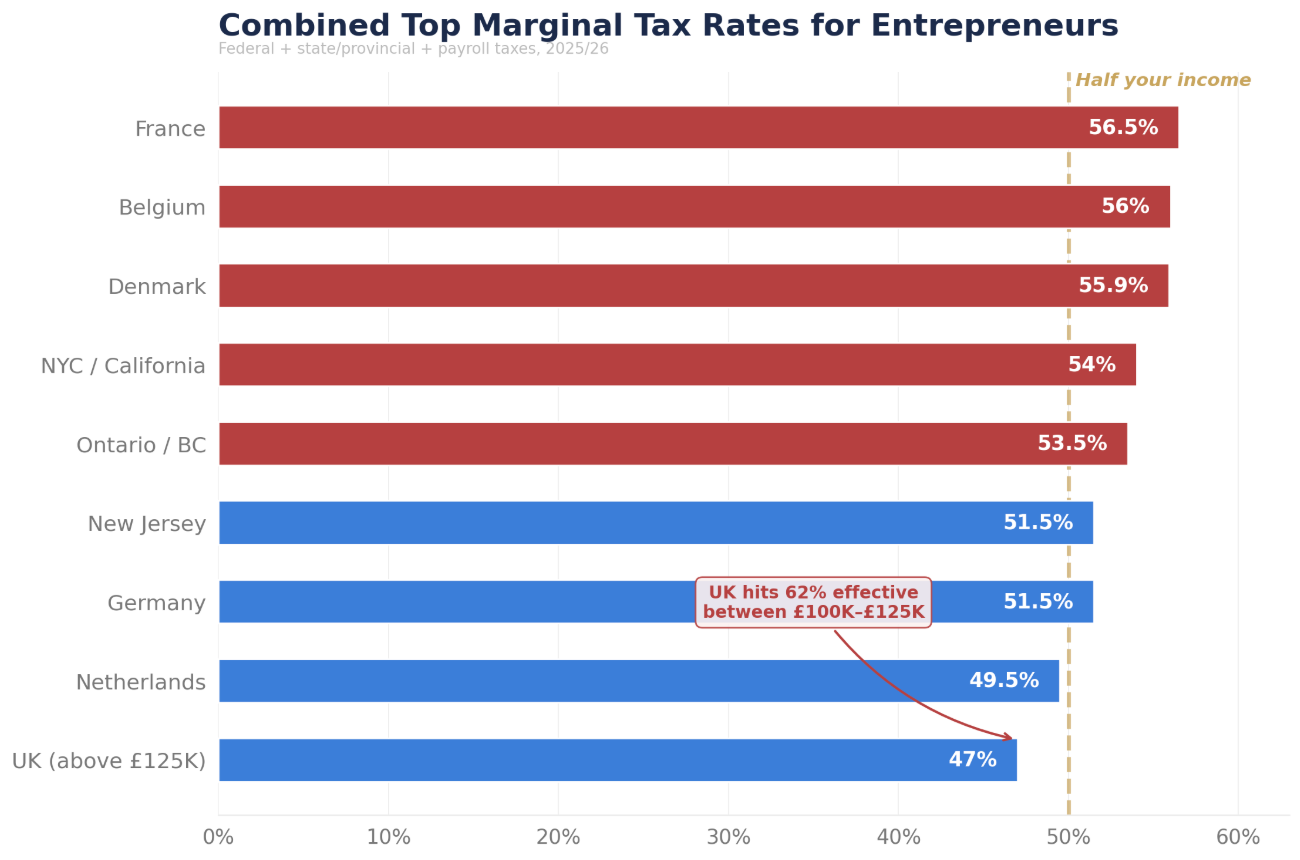
If you’re an entrepreneur earning north of $500,000 in virtually any major Western jurisdiction, roughly half of every additional dollar you earn goes to the government. Not as a choice. As a mathematical fact.
In New York City, a successful entrepreneur faces a combined marginal rate of about 54.3%. That’s 37% federal, plus 9.65% state, plus 3.876% city, plus 3.8% Medicare surtax. California is nearly identical at 54.1%. Across the border in Ontario, it’s 53.53%. British Columbia, 53.50%. Quebec, 53.31%.
In the UK, the top rate is technically 47%. But a stealth mechanism called the personal allowance taper creates an effective 62% marginal rate between £100,000 and £125,140. France reaches 55–58% when you stack income tax, social charges, and surcharges. Denmark hits 55.9%, the highest in the OECD. Belgium reaches 54–58%. Germany, Sweden, and the Netherlands all hover in the low 50s.
Think about what this actually means. You pour years into building something. You take the risk. You hire people. You create value that didn’t exist before. And your government, which took none of the risk, claims more than half of every incremental dollar as its reward.
When governments take more than half of what you earn, they aren’t your partner. They’re your majority shareholder. And they bring nothing to the table except overhead.
$2 trillion in invisible regulation
Beyond the visible tax burden, there’s the regulatory toll. It never shows up on your return, but it hits your bottom line just the same.
The Code of Federal Regulations now spans 188,343 pages. Up 723% since 1960. The Competitive Enterprise Institute estimates annual regulatory compliance costs at $2.155 trillion, roughly 7.3% of GDP. The National Association of Manufacturers puts the figure at $3.079 trillion. If federal regulation were its own country, it would be the world’s eighth-largest economy.
Here’s the part that should make every entrepreneur’s blood boil: the burden is wildly regressive. Firms with fewer than 50 employees pay $14,700 per employee per year in compliance costs. For small manufacturers, it’s $50,100 per employee. A shop with 20 workers faces roughly $1 million in annual compliance overhead.
Large corporations can absorb this. They have legal departments, compliance teams, and lobbyists who helped write the regulations in the first place. Small businesses get crushed. The ones doing the actual innovating. And they’re supposed to thank the system for the privilege.
The Heritage Foundation’s 2025 Index of Economic Freedom ranked the U.S. at its worst-ever position: 26th globally. Twenty-sixth. Behind Estonia, Lithuania, and Mauritius.
This is a Western problem, not an American one
If you’re Canadian, British, French, or German reading this and thinking “well, at least we’re not the U.S.,” I have bad news.
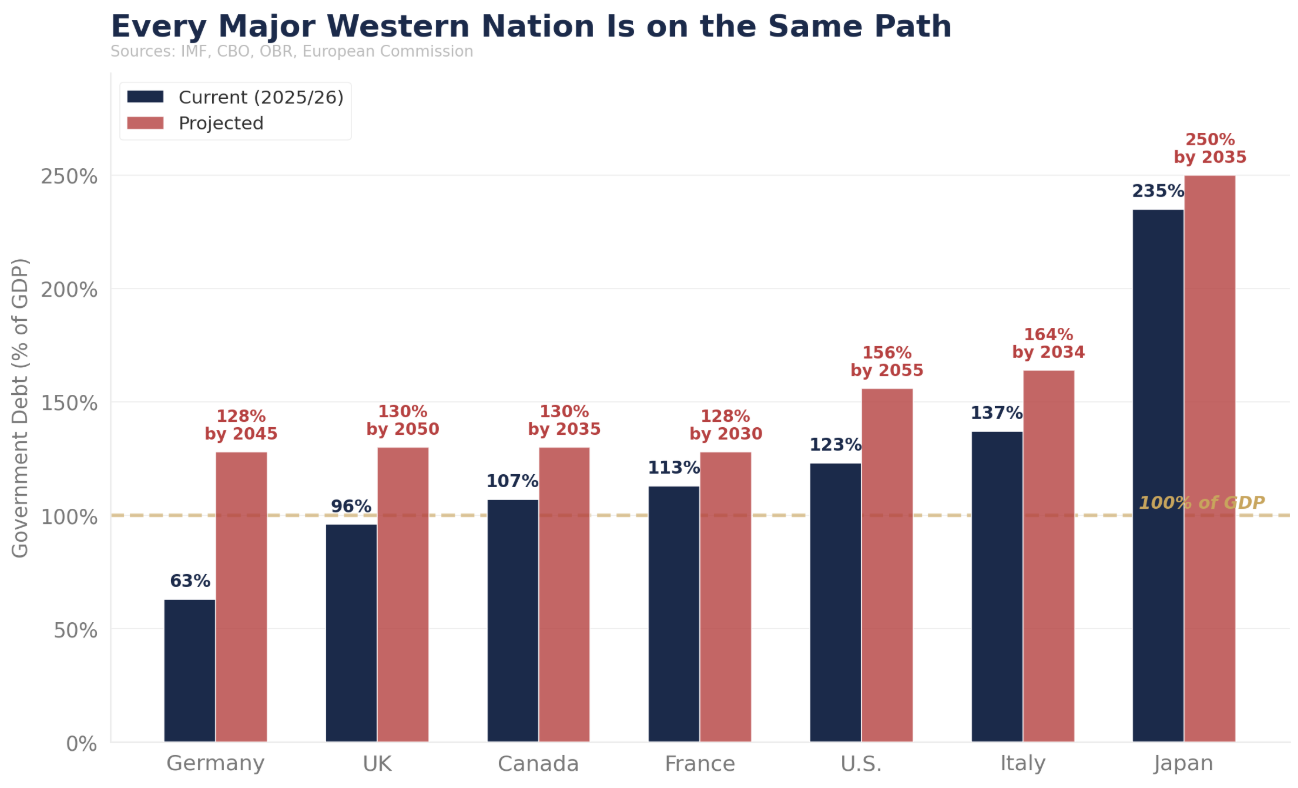
The UK’s public sector net debt stands at roughly 96% of GDP. The OBR projects it could reach 350% within 50 years if aging-related spending goes unaddressed. The Henley Private Wealth Migration Report projects 16,500 millionaires will leave the UK in 2025, carrying an estimated $92 billion with them. The largest single-year exodus ever recorded.
France’s government debt hit 113.1% of GDP, with the deficit at 5.8%, nearly double the EU’s 3% limit. The country is under formal Excessive Deficit Procedure. Its tax-to-GDP ratio of 45.6% is the highest in the EU. And the deficits persist anyway, because spending growth outstrips even this extraordinary level of extraction.
Germany was Europe’s fiscal anchor for decades. Then in March 2025, it broke its own constitutional “debt brake” to create a €500 billion infrastructure fund. The OECD projects German debt could reach 128% of GDP by 2045. Its elderly-to-working-age ratio will approach one pensioner for every two workers by 2050.
Italy carries debt of 137.3% of GDP heading toward 164% by 2034. Japan sits at 235% with the oldest population in the developed world.
Across the OECD, the old-age dependency ratio has risen from 19% in 1980 to 31% today. It’s projected to reach 52% by 2060. One retiree for every two workers. And every Western government’s entitlement system was designed for a population pyramid that no longer exists.
The pattern that never changes
If you’ve read this far and you’re thinking “surely this time is different,” study history. It’s never different. Only the names change.
The Roman Empire debased its currency from 98% silver to about 2% over three centuries. Each emperor rationalized “minor adjustments.” By the end, wine that cost 1/8 denarius cost 8 debased denarii. An effective 6,300% price increase. Citizens fled productive activity. The monetary economy collapsed into barter.
The Spanish Empire controlled the gold and silver of the entire New World and still defaulted on its sovereign debts 13 times. The wealth flowed through Spain to pay foreign creditors rather than building anything productive.
Pre-revolutionary France spent half of government income on debt service by 1789. The tax system exempted the privileged while crushing the productive class. What followed was not a policy adjustment.
Fiscal excess. Currency debasement. Tax increases on the productive class. Capital flight. Decline. The pattern is always the same. The only variable is speed.
142,000 millionaires are doing the math
While Western governments extract 47–58%, a growing number of jurisdictions compete for mobile entrepreneurs at 0–15%.
The UAE charges zero personal income tax and 9% corporate. Panama operates a territorial tax system where foreign-sourced income is completely exempt. Singapore’s corporate rate is 17% with startup exemptions dropping the effective rate to about 4% on the first SGD 100K, with zero capital gains tax. Paraguay offers a 10% flat corporate tax and zero on foreign income. Portugal’s IFICI regime provides a flat 20% rate on qualifying income for ten years. Georgia charges 1% on turnover for small businesses.
These aren’t obscure loopholes. These are national policies. Countries actively competing for exactly the kind of person reading this article.
The Henley Private Wealth Migration Report projects a record 142,000 millionaires will relocate internationally in 2025, up from 128,000 the year before. U.S. nationals now represent over 30% of all investment migration applications, with a 200% increase in Q1 2025 compared to the prior year.
Between 2020 and 2023, 2.8 million more Americans moved out of high-tax states than moved in. California lost $11.9 billion in adjusted gross income. New York lost $9.9 billion. Over the past decade, New York has hemorrhaged $111 billion in AGI to zero-income-tax states.
People are already voting with their feet. The question is whether you’ll be ahead of the curve or behind it.
What this means for you
If you’re an entrepreneur in your twenties, thirties, or forties, building a business, creating impact, working to secure a future for yourself and your family, you need to confront something uncomfortable.
The system you were raised in, the one that promised you’d be rewarded for hard work and playing by the rules, is mathematically insolvent. The debt will be paid. One way or another. Higher taxes. Inflation that erodes your purchasing power. Benefit cuts. Or most likely all three at once.
You have roughly 10–20 years before the worst of it hits. Social Security depletes in 2033. The CBO projects debt surpasses the WWII record by 2029. Interest payments are already eating more than defense. And every single Western peer nation faces the same demographic time bomb.
But here’s what I want you to understand: this isn’t a doomsday prediction. It’s a strategic opportunity.
The entrepreneurs who navigate the next two decades well will be the ones who understood that the world is not one country. That tax residency is a choice, not a birthright. That asset protection isn’t paranoia, it’s fiduciary duty. That your business can serve clients globally while you structure your life in a jurisdiction that actually wants you there.
That’s what The Sovereign Entrepreneur is about. This Substack, and the podcast that goes with it, exists to give ambitious, globally-minded entrepreneurs the frameworks, data, and strategies to build wealth and freedom on your own terms. Not by gaming the system. By understanding it better than anyone else in the room.
If this resonated, subscribe. Share it with a founder who needs to see the numbers. And welcome to the conversation.
Next week: The Passport Portfolio — why strategic residency planning is the most underrated wealth-building tool in the world.
The Sovereign Entrepreneur is sponsored by Grey River Associates, a boutique cross-border tax advisory and wealth structuring firm helping entrepreneurs navigate global living, entity structuring, strategic residencies, asset protection, and tax optimization. Offices in Toronto, Miami, Panama City, San Juan, and Madrid. If the numbers in this article hit close to home, book a confidential consultation.
Nate is the Founder and Managing Partner of Grey River Associates. CFA, ADIT, STEP. MBA, Yale. LLM candidate, King’s College London. Nine countries and counting.