
The Global Talent Arbitrage
Why high-income professionals are leaving the West — and building fortunes where their skills are scarce.

The Western job market has too many credentials chasing too few opportunities. The people who close that gap will build the next generation of wealth.

Here is the situation facing a talented 32-year-old in Toronto, London, or New York in 2026. She has a top-tier MBA, four years at a Big Four firm, a CPA, and strong references. She applies for a senior manager role at a mid-market company. So do 400 other people. She gets the job.
It pays C$155,000. After Canadian federal and provincial tax, other payroll deductions (CPP, and EI) she takes home roughly C$102,000. Her rent for a two-bedroom in downtown Toronto is C$3,000 a month — C$36,000 a year. Student loan payments run another C$12,000. She saves maybe C$25,000 if she’s disciplined.
At 3% real returns — which is what we will argue in our next piece titled the Lost Decade Ahead, is the realistic forward expectation for developed-market equities — that C$25,000 annual savings compounds to about C$840,000 by age 55. This is barely enough to fully own a two bedroom condo in Toronto today.
Now consider her classmate. Same credentials. Same ambition. He took a different path. He left the Big Four after three years, moved to Panama City, and started an independent consulting practice advising Latin American mining companies on financial controls and ESG compliance — skills he built in Toronto, applied where they’re scarce.
He bills $100,000 in his first full year (all US dollars), growing to $250,000 by year three. Under Panama’s territorial tax system, his foreign-source consulting income is taxed at zero. His rent in a modern high-rise in Panama City’s banking district is $1,400 a month.
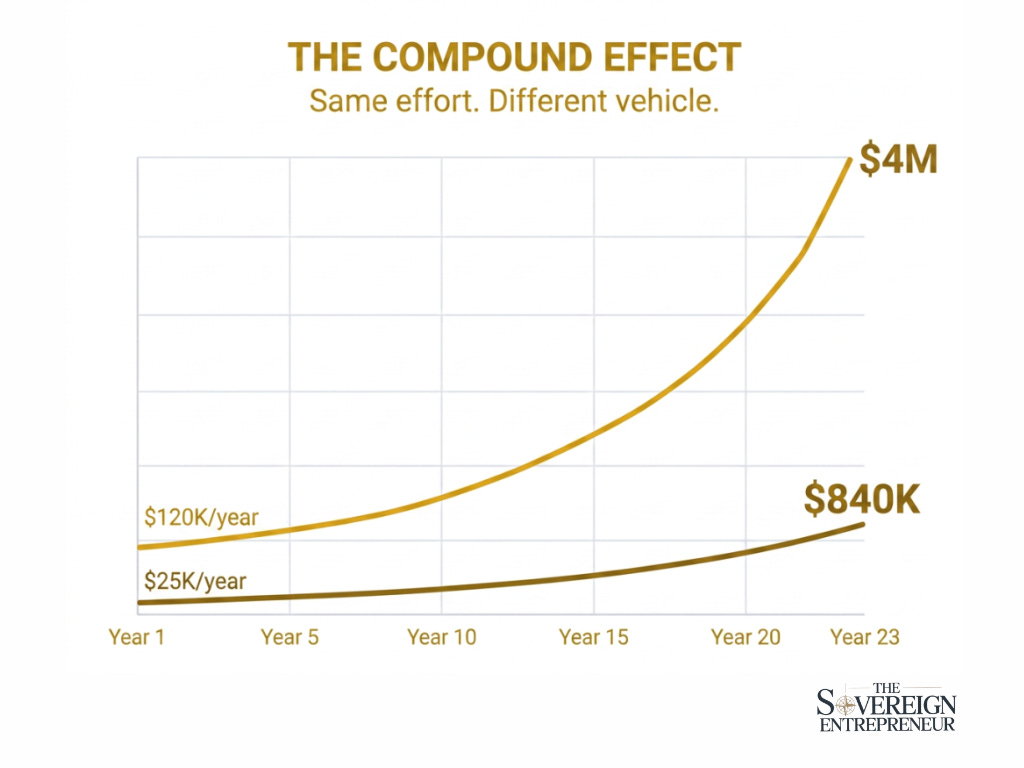
After he builds his practice, he saves $120,000 a year. At the same 3% real return, that compounds to $4 million by age 55. (We haven’t even taken into account that the investment returns compound tax-free in this scenario compared to the former).
Same person. Same credentials. Same number of working hours. Many times the wealth outcome.
This essay is about that structure — and why we believe it represents the single most important career decision available to ambitious Western professionals in the next decade.
• • •
The Western Talent Glut
The developed world’s professional job market is suffering from a problem that no one wants to name plainly: there are too many highly credentialed people chasing too few high-quality positions.
The Fortune 500, Big Four (Deloitte, PwC, EY, KPMG), MBB (McKinsey, Bain, BCG), High Finance (Blackstone, Goldman and the like), Big Law (the AmLaw 100 and Magic Circle), and Big Tech (FAANG/Magnificent 7) collectively represent the aspirational career tracks for millions of university graduates across North America, the UK, and Europe. These institutions have spent decades building the mythology that a career within their walls — the prestige, the training, the network, the exit opportunities — is the surest path to professional and financial success. And for a long time, it was. It isn’t anymore.
The math has changed in three ways simultaneously, and each one compounds the others.
1. The Credential Inflation Problem
In 2000, about 1.2 million bachelor’s degrees were conferred annually in the United States. By 2023, that number exceeded 2.1 million. MBA enrolments have followed a similar trajectory globally. The CFA Institute now has over 200,000 charterholders worldwide, up from roughly 50,000 in 2000. The supply of credentialed professionals has roughly doubled in a generation.
But the number of senior positions at elite firms has not doubled. McKinsey has about 45,000 employees globally — large by consulting standards, but a rounding error relative to the number of MBAs and business graduates produced each year. Goldman Sachs employs about 46,000 people. The entire AmLaw 100 employs perhaps 200,000 lawyers. The competition for these roles is ferocious, and it is intensifying every year as credential supply outpaces demand.
The result: longer hiring processes, more unpaid internships, more “rotational programs” that defer real responsibility, lower starting salaries in real terms, and a pervasive culture of anxiety. A 2024 Deloitte survey found that 52% of Gen Z respondents reported feeling stressed “all or most of the time.” The prestige-track career that was supposed to provide security and prosperity now provides neither — just a treadmill with a good logo.
2. The Tax and Cost-of-Living Squeeze
The credential problem would be manageable if the after-tax, after-housing economics were favourable. They aren’t.
A senior associate at a Big Four firm in Toronto earns roughly CAD $110,000–$130,000. After federal and Ontario provincial income tax (combined marginal rate: ~43% on income above $100,000), CPP contributions, and EI premiums, she takes home approximately $75,000–$85,000. Average rent for a one-bedroom apartment in Toronto: $2,400/month ($28,800/year). Average condo price: $680,000 — requiring a $136,000 down payment that would take five to six years of aggressive saving, during which she can’t invest in anything else. Her effective savings rate, after tax and housing, is often below 10%. At that rate, meaningful wealth accumulation is a multi-decade project with no margin for error.
London is worse. A senior associate at a Magic Circle law firm earns £100,000–£130,000. After income tax (40% above £50,270), National Insurance (2%), and student loan repayment (9% above £27,295 for Plan 2), effective take-home is roughly £65,000–£75,000. Average rent for a one-bedroom in Zone 1–2: £2,000–£2,500/month. Home ownership in London requires a deposit of £80,000–£120,000 for a modest flat. The financial treadmill is faster and the destination is further away.
San Francisco, New York, Sydney, Paris, Milan, Zurich — the same story with different currencies. The cities where the elite jobs are concentrated are precisely the cities where the after-tax, after-housing economics are most punishing.
3. The AI and Restructuring Overhang
And now, on top of the credential glut and the cost squeeze, the jobs themselves are becoming less secure.
Big Law firms are deploying AI for document review, due diligence, and contract analysis — tasks that once employed armies of junior associates billing at $400–$600/hour. The Big Four are automating audit procedures and advisory workflows. Management consultancies are using AI to generate the slide decks and data analyses that were the bread and butter of first-year associates. Big Tech has laid off over 400,000 workers since 2022.
The junior and mid-career roles that were the traditional on-ramp to senior positions are being hollowed out.
The professionals who remain are working harder, under more pressure, with less job security and flatter promotion curves. A recent survey by the International Bar Association found that 48% of young lawyers reported symptoms of burnout.
Consulting firms have extended “up or out” timelines while reducing the ratio of partners to associates. The implicit contract — work brutally hard for a decade and you’ll be rewarded with partnership, equity, and security — is fraying.
The question is not whether this is happening. It’s what to do about it.
• • •

The Other Side of the Equation
While the developed world drowns in credentialed talent, the fastest-growing economies on earth are starving for it.
The oil and gas industry globally faces a workforce where the average age is 56 and over half of experienced engineering professionals are expected to retire within the next decade. Only 12% of the workforce is under 30.
Engineering and technical operations roles are the single hardest to fill across every geography. The mining sector in Latin America is even more acute: copper demand is rising 3–4% annually through 2030, lithium demand is forecast to double by 2030, and Argentina, Chile, and Peru are all scaling major projects — but project developers can’t find enough talented project managers, environmental compliance specialists, or financial controllers.
The Gulf states — Saudi Arabia, the UAE, Qatar — are deploying over $2 trillion in Vision 2030 and related diversification programmes. They need portfolio managers, fund administrators, compliance officers, urban planners, hospitality operators, and healthcare administrators. India’s economy is growing at 6.5% real and needs tech executives, financial infrastructure builders, and international go-to-market specialists. Vietnam’s industrial economy grew over 8% in 2025 and needs factory managers, supply-chain engineers, and quality-control specialists.
Sub-Saharan Africa will add roughly 740 million working-age people by 2050 — 12 million entering the labour market every year. The infrastructure to support them — roads, ports, power, water, housing, telecoms — largely doesn’t exist yet. The construction managers, civil engineers, project financiers, and regulatory specialists who build it will write their own terms.
In the West, you are one of thousands competing for a shrinking pool of roles. In these markets, you are one of a handful who can do what needs doing. That asymmetry is the opportunity.
• • •
The Historical Precedent
This is not a new pattern. Every major emerging-market growth wave in the last century created a generation of expatriate professionals who captured outsized wealth by deploying developed-world skills in developing-world markets.
The British and American engineers who built Saudi Aramco in the 1940s and 1950s didn’t just earn salaries — they built relationships and institutional knowledge that made them indispensable for decades.
The Western bankers and lawyers who opened the first foreign offices in Hong Kong, Singapore, and Shanghai in the 1980s and 1990s built franchises that still dominate Asian deal-making.
The traders and financiers who entered Moscow in the 1990s — when Russia’s economy was in chaos but its assets were absurdly undervalued — earned returns that were impossible in mature markets.

In every case, the playbook was the same: take skills that are abundant where you come from, and deploy them where they are scarce. The compensation, the deal flow, the equity participation, and the career velocity in talent-scarce markets exceed anything available in talent-saturated ones — often by multiples.
The question is not whether this pattern will repeat. It already is. The question is whether you’re positioned to capture it.
• • •
What We’re Seeing in Practice
At Grey River Associates, our cross-border tax advisory and wealth structuring practice, we work with high-income professionals and entrepreneurs operating across borders. Over the past two years, we have observed a significant and accelerating shift in our client base. More professionals — younger, more ambitious, more internationally minded than ever — are leaving traditional Western corporate tracks and redeploying their skills into high-growth emerging markets.
Here are the archetypes we see most frequently:
The Mining and Energy Consultant
A Canadian or Australian with 8–15 years of experience in project management, geological assessment, environmental compliance, or financial controls. They leave a $160,000 corporate role, establish an independent consultancy, and contract with lithium developers in Argentina’s Salta province, copper operators in Peru, or offshore oil producers in Guyana. They bill $200 per hour — ~$500,000 annually — because Western-trained project professionals with actual operational experience are desperately scarce. They bases themselves in Panama City or Uruguay, where foreign-source income is taxed at zero, and cost of living is a fraction of that of Canada or the US, and only a two-hour flight from Bogotá, Lima, or Mexico City.
The Tech Executive Who Kept Everything
An American product leader earning $280,000 — $180,000 base plus $100,000 in RSUs — at a growth-stage fintech in New York. After federal, New York State, and city income tax, his combined marginal rate exceeds 51%. He takes home roughly $155,000 before rent. His $5,000/month Manhattan apartment eats another $60,000. He saves maybe $30,000 a year if he’s disciplined.
He keeps the same job and moves to Panama City.
The company doesn’t care. Half her team is remote anyway. She’s in the same time zone as New York, a five-hour direct flight when she needs to be in the office. Under Panama’s territorial tax system, her salary paid by a US entity for work performed for foreign clients and operations is structured as foreign-source income. Her tax rate drops from 51% to zero. Her rent drops from $3,800 to $1,500. On the same gross pay, she now saves $180,000+ a year.
Then the upside layer kicks in. With her evenings free and her professional network intact, she starts advising early-stage startups — a crypto exchange in Hong Kong, a logistics platform in Bogotá, a healthtech company in London. She takes advisory equity in three companies (0.25–0.5% each) and earns $60,000 a year in consulting fees. In New York, the consulting income would be taxed at 51%+. The equity, when it vests or exits, would face federal capital gains plus the 3.8% net investment income tax plus New York’s 10.9% state rate. In Panama, all of it — the consulting fees, the option exercises, the equity exits — is taxed at zero.
Same employer. Same Slack channels. Same career trajectory. But she’s saving $180,000 a year instead of $50,000, building an advisory portfolio on the side with no tax friction, and living in a modern high-rise ten minutes from the ocean. By year five, her liquid net worth exceeds $1 million from savings and advisory exits alone — before any appreciation on her primary company’s RSUs.
The Energy Executive Spanning Three Continents
A Nigerian-born petroleum engineer who spent twelve years in Houston — field engineer to senior project manager at a major operator. He knows deepwater development, FPSO commissioning, upstream economics, and the regulatory frameworks of half a dozen producing jurisdictions. He was earning $210,000, paying 37% federal tax, and watching his career ceiling approach: the senior technical roles above him were filled by people five years from retirement who weren’t going anywhere.
He formed his own consultancy and based it in Panama City. From Panama he manages three markets: West African offshore development in Nigeria, Ghana, and Senegal, where he has the relationships, language, and cultural fluency no American or European competitor can match; Guyana, where ExxonMobil’s Stabroek block is producing over 600,000 barrels per day and scaling toward 1.2 million by 2027, creating an entire upstream services ecosystem from scratch; and Houston, where the capital, the engineering firms, and the procurement decisions still sit. Panama puts him five hours from Houston, four from Georgetown, and an overnight from Lagos.
His consultancy earns $400,000–$600,000 annually across long-term retainers with national oil companies, project-management contracts with IOCs in Guyana, and success fees tied to development milestones in West Africa. His foreign-source income is taxed at zero in Panama. He saves $250,000+ a year which he invests in his own oil and gas ventures, which have upside in the 7 figures. And his competitive moat is nearly impossible to replicate — Nigerian cultural fluency, Houston technical pedigree, Guyanese operational experience, all run from a base with direct flights to every market he serves. The Big Four are trying to staff these same engagements with 28-year-old associates who’ve never been to a wellsite. He wins every pitch.
• • •
The Structuring Layer
The business opportunity in going independent is compelling. But when you layer on the tax advantages of going your own way, it is incredible.
The common thread among all of these professionals is that they are earning high incomes from globally mobile skills, often with no fixed obligation to be in any particular country. That creates the opportunity to choose a tax residence that aligns with wealth building rather than wealth extraction.

The key jurisdictions we work with at Grey River, and the logic behind each:
Panama — territorial taxation. Foreign-source income is not taxed. Period. This means a consultant based in Panama City, billing clients in Chile, Peru, Argentina, and Colombia, pays zero income tax on that revenue. Panama also offers one of the world’s most straightforward residency programmes, a stable US-dollar-denominated economy, and a strategic geographic position — a two-to-four-hour flight from most of Latin America, less than 3 hours from Miami, direct connections to Madrid. It is, in our view, the single best base for professionals serving the North America to Latin American growth corridor.
The UAE (Dubai, Abu Dhabi) — zero personal income tax, world-class infrastructure, the Golden Visa (10-year renewable residency), and access to the Gulf’s $2+ trillion transformation. Ideal for financial professionals, consultants, and entrepreneurs serving the MENA region.
Puerto Rico — Act 60 offers 4% corporate tax and 0% on qualifying capital gains for bona fide residents. US citizens retain US citizenship and passport while dramatically reducing their tax burden. Ideal for American entrepreneurs and investors.
Malta, Cyprus, Georgia, Paraguay — various regimes offering low or territorial taxation, EU access (Malta, Cyprus), or extremely low cost bases (Georgia, Paraguay) for digital businesses and remote professionals.
The structuring itself — the entity formation, the tax-residency determination, the compliance filings, the investment custody, the estate planning — is what we do at Grey River. We are not a travel blog or a lifestyle brand. We are a cross-border tax advisory and wealth structuring firm that exists to help high-income, globally mobile professionals keep more of what they earn, invest it intelligently across jurisdictions, and build wealth that is protected and compounds over decades.
• • •
The Operating System for Sovereign Entrepreneurs
We use the phrase sovereign entrepreneur deliberately. It describes a person who has taken intentional control over the structural variables that determine wealth and lifestyle outcomes — where they live, where their business is domiciled, how their income is taxed, where their investments are custodied, and how their estate is structured.
These individuals recognize that the global system is not uniform — that there are jurisdictions that actively compete for mobile talent and capital by offering lower taxes, simpler regulation, and higher quality of life. And it is about making the deliberate, informed, fully compliant decision to operate from those jurisdictions rather than passively accepting the tax and cost structure of whatever country you happened to be born in.
The Western professional who earns $300,000 in Toronto, pays $140,000 in tax, spends $50,000 on housing, and saves $40,000 is making an implicit choice. He is choosing to let the Canadian government — not him — decide how much of his productivity he keeps. The sovereign entrepreneur makes a different choice. He keeps his Canadian passport, maintains professional relationships, and serves the same clients — but operates from a base where the structural economics are in his favor rather than agains him.
Our passion at Grey River is being the operating system for these people. The high-income earners. The ambitious builders. The globally mobile professionals who have the skills the world needs and the willingness to go where those skills are valued most.
We believe the next decade will produce a generation of sovereign entrepreneurs who build more wealth, with less stress, in less time, than any generation of corporate employees. Not because they are smarter or luckier — but because they recognised that the most important financial decision is not what to invest in, but where and how to structure your life.
The Western job market is oversaturated. The rest of world is undersupplied. The tax code is not uniform. The arbitrage is real, it’s legal, and it’s available right now.
The question is whether you’ll capture it — or watch from the sidelines while others do.
• • •
If this resonates, we’d like to hear from you.
Grey River Associates works with high-income professionals and entrepreneurs who are ready to restructure their lives for the decade ahead.
greyriverassociates.com • info@grey-river.com
About the Author

Nate Shantz is the Founder and Managing Partner of Grey River Associates, a cross-border tax advisory and wealth structuring firm with presence in Toronto, Miami, Panama City, San Juan (Puerto Rico), and Madrid. He holds a Yale MBA, CFA charter, and ADIT qualification, and is pursuing an LLM in International Tax Law at King’s College London. He writes about sovereign competition, international tax strategy, and the structural forces shaping global capital flows.
Subscribe to The Sovereign Entrepreneur at sovrepreneur.com