Lean Teams, LLMs, and the Erosion of the $1T Professional Services Pyramid
Inside the structural shift that's turning solo operators into competitors of Deloitte, McKinsey, and Kirkland & Ellis.

I’ve been thinking about professional services firms for a long time.
Not because I find accounting, law, engineering, or environmental studies firms fascinating.
Because the economics of professional services firms are changing in a way that creates enormous opportunity.Here’s the basic problem.
Professional services is a $1 trillion industry.
Consulting, law, accounting, engineering, audit, project management, staffing, executive search - all of it.
And nearly all of it runs on the same business model: hire smart people, bill their time by the hour, and charge a premium for the brand name on the cover page.
That model worked for fifty years. It’s now breaking.

* * *
First Principles: What Is a Professional Services Firm, Really?
Strip away the marble lobbies and the partner titles and you’re left with something simple.
A professional services firm is an arbitrage on judgment.
The client has a problem. They don’t have the expertise to solve it. So they rent someone else’s expertise by the hour. The firm’s job is to find people with that expertise, organize them, and mark up their time.
That’s it. That’s the whole trick.
The firm adds three things: a brand (so the client trusts you), a system (so delivery is consistent), and leverage (so one partner’s relationships generate fees across many juniors).
The brand and heritage of a firm is real. The system of implementation also matters. But the leverage is where the money is.
A McKinsey partner sells a project for $800,000. A team of four associates does the work over 6-8 weeks. Each associate costs the firm maybe $50,000 for the duration of the project. The partner spends a few hours a week on it. The firm pockets the difference.
It’s a beautiful model… until LLMs have come into the picture, making clients more demanding and putting pressure on margins.
* * *
What AI Actually Does to This Model
Most people think AI is a tool that makes consulting faster. That misses the point entirely.
AI doesn’t make the pyramid more efficient. It makes the pyramid unnecessary.
The traditional model looks like this: one partner (sells and owns the relationship), one manager (runs the project day-to-day), four associates (do the research, build the models, make the slides).
The partner and the manager are hard to replace. They have judgment, relationships, and domain expertise.
The four associates? Their job is to take instructions, gather data, analyze it, and present it in a structured format.
That is exactly what LLMs do.
McKinsey figured this out. They now run 20,000 AI agents alongside 40,000 humans.
A project that used to need six people now needs three.
Maybe two.
The base of the pyramid is collapsing.
This is why entry level hiring is very low, even for ivy league graduates now and is only trending worse.
But here’s the thing MBB consulting firms, Big Law, and large professional engineering firms like WSP don’t want to acknowledge:
Every associate they replace with technology may undermine their entire business model in the medium term.
The whole model depends on billing junior hours at senior rates. If the juniors are gone, the leverage disappears.
And leverage is where the profit was.
This is the classic innovator’s dilemma.
The technology that makes you better also destroys the thing that made you money.
* * *
The Principle: Specific Knowledge + Leverage = Wealth
Naval Ravikant has this framework I keep coming back to:
Income = Specific Knowledge × Leverage × Accountability
Professional services is the purest expression of this formula.
The specific knowledge is your domain expertise - whether it be international tax law (in the case of my firm, Grey River), mining engineering, M&A due diligence, management consulting, whatever.
The leverage used to be people. You needed a team to execute.
AI changed the leverage equation.
Now the leverage is the tool. One person with deep domain expertise and the right AI stack can produce what a team of six produced two years ago. The specific knowledge hasn’t changed.
The leverage has gotten dramatically cheaper and more accessible.
This is great news if you’re the person with the specific knowledge. It’s terrible news if you’re the institution that was charging a 4x markup on other people’s specific knowledge.
* * *
How This Plays Out in Practice
I’ll use my own firm as an example.
Grey River does cross-border tax advisory.
We help entrepreneurs and high-net-worth individuals structure their affairs across multiple jurisdictions - whether Caribbean, Panama, Canada, the US, Europe.
Tax planning, entity structuring, residency strategy, wealth management.
All integrated into one engagement.
The Big Four (EY, KPMG, Delloitte, PWC) do this work too.
But they do it badly for clients at our level, and I can explain exactly why.
They’re organized in silos. The corporate tax team doesn’t talk to the personal tax / immigration team. The entity structuring group doesn’t coordinate with the wealth management desk. The client gets five advisors who each see one piece of the puzzle and none of whom see the whole picture.
They’re too expensive for the wrong reasons. You’re not paying for expertise. You’re paying for the office in Manhattan, the graduate recruiting machine, the brand, and the three layers of review that exist because the person doing the actual work is 24 years old and learning on your dime.
They don’t answer the phone. I mean this literally. When a Grey River client has a question, they hear back the same day, usually the same hour, from the person who actually knows their structure. At a Big Four firm, that question can sit in a queue for three days. A lot of the files get lost in the shuffle.
We can do this because we’re small, focused, and we use AI to augment the work that used to require a team.
Treaty research, compliance memo drafting, financial modeling, structure comparison - all of it gets done in hours or days instead of weeks.
The client gets better work, faster, at a lower price. We get higher margins.
This isn’t unique to tax. The pattern is the same everywhere.
* * *
Where the Opportunities Are
If you are currently an employee of a professional services firm, the time is now to launch your own thing.
You can take market share within your niche from the big guys, while building financial freedom along the way.
I mapped thirteen categories of professional services and scored them on vulnerability to AI disruption.
The scoring is based on four factors: does the work require physical presence, is there a regulatory license requirement, is the core work data-intensive, and does the firm bill by the hour.
Note: the higher the score, the more opportunity is available for you to go into the industry as a solopreneur or smaller boutique firm and take margin from the bigger players.
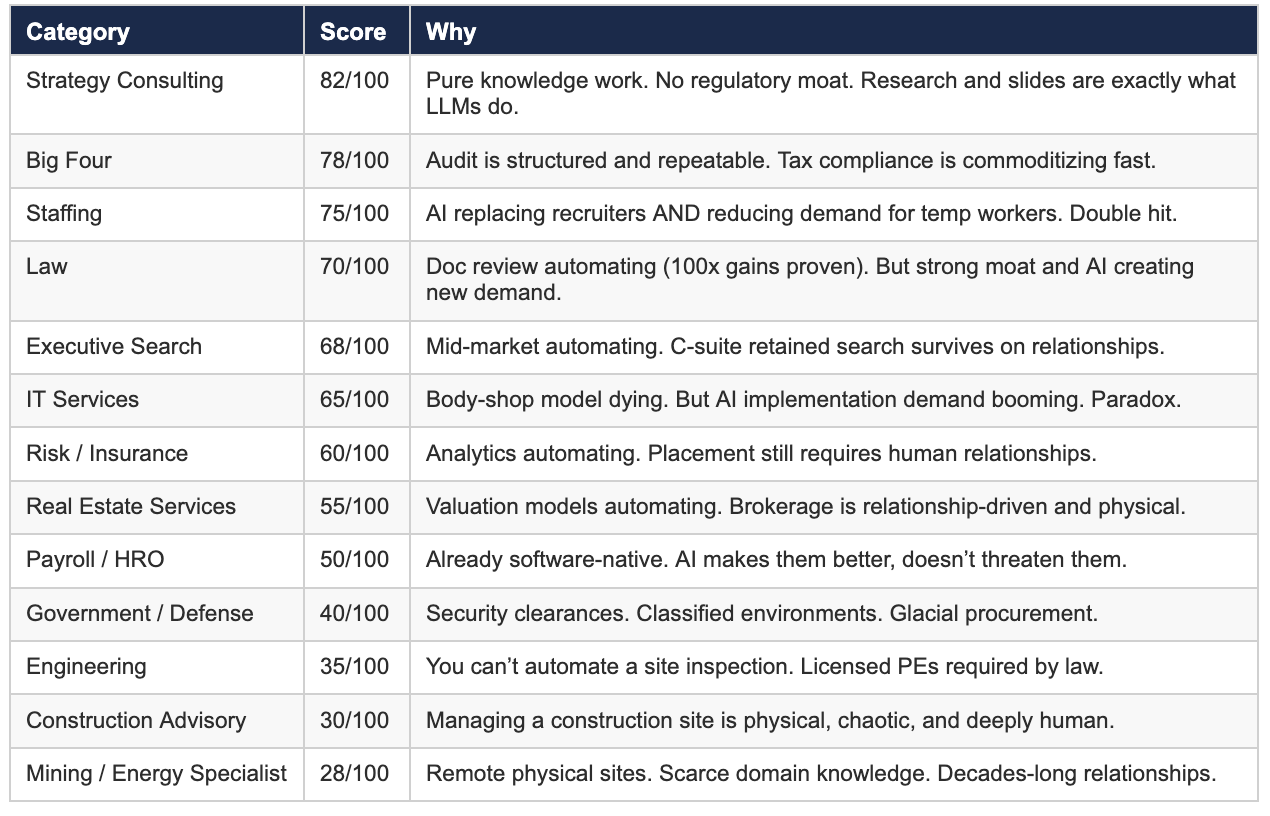
The higher the score, the more margin is available to someone who can deliver equivalent quality at lower cost with a smaller team.
* * *
The Structural Advantages of Doing This as a Sovereign Entrepreneur
Here’s where this gets interesting. And this is the part most people miss.
Professional services have a unique characteristic: the work product is information. A memo. A model. A structure. A strategy. A legal opinion. It’s bytes, not atoms.
It’s not physical. The work travels digitally by e-mail.
This means you can do the work from anywhere.
Yes, there are moments that require physical presence. A site visit. A bank meeting. A client dinner. But those are periodic trips, not permanent requirements. You fly in for a few days and come home.
And “home” can be anywhere.
This matters because of a simple equation:
Take-home income = Revenue − Costs − Taxes
A Big Four partner in New York generates $3 million in revenue. The firm takes its cut to cover rent, salaries, compliance costs, corporate taxes etc.
The partner keeps maybe $600,000–$800,000. Maybe. Then New York State takes its cut. Then New York City takes its cut. Then the federal government takes its cut.
The end result is a net take home pay of $300,000 to $400,000.
A solo operator in San Juan, Puerto Rico, or Panama City, Panama generates $800,000 in revenue. Panama has a territorial tax system - income earned from foreign clients isn’t taxed. For Americans, Puerto Rico allows for total income tax of 4% (Act 60 Exemption).
The operator keeps $750,000. Lower revenues yes, but much higher take home pay.
Same Zoom call. Same deliverable. Same client outcome. Radically different economics.
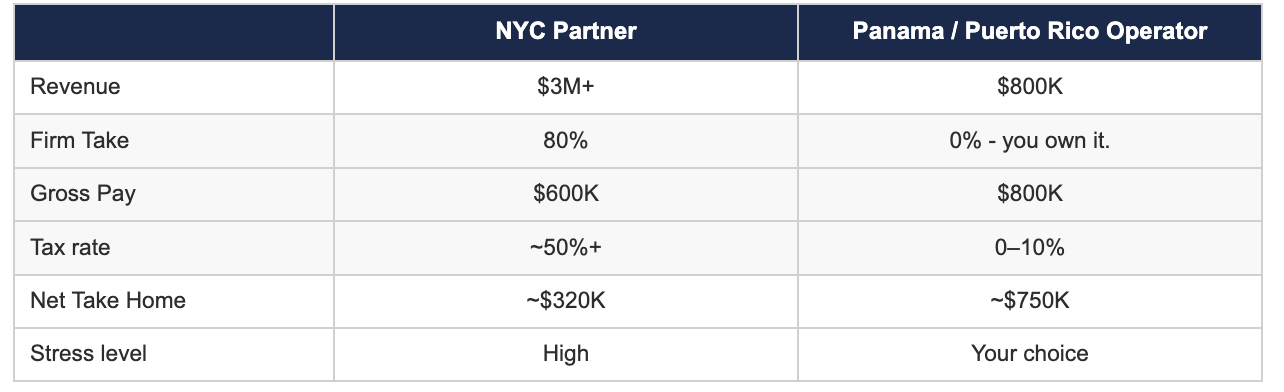
The solo / lean operator likely has a lower cost of living and also can re-invest profits back into the business or other investments to compound wealth at a faster rate (with a much lower tax drag).
In my experience, oftentimes the client doesn’t care where you sit.
They care whether you understand their problem and whether you solve it.
And oftentimes the nimble operator can provide much better service, with more streamlined results at a reasonable cost.
Very Profitable for the Operator. Very effective for the client.
* * *
The Clients We See Doing This
This isn’t theoretical. We work with people who are doing exactly this across multiple verticals.
We have clients in energy and oil and gas project management. They spent twenty years managing upstream projects in Canada and West Africa. They know the regulatory landscape, the contractor ecosystem, the safety requirements, the cost structures. That knowledge is scarce.
The large EPC firms - Worley, Wood, Hatch - charge enormous rates and staff projects with people who don’t have the same depth.
Our clients undercut them on price, outperform on quality, and use AI for the reporting and documentation work that used to require a back office. They operate from tax-efficient jurisdictions. They fly to site when they need to. They live well.
More importantly, oftentimes our clients work with the larger firms to offer support. As a solo or lean operator, you can provide these services as a subcontractor to the large firms. They benefit from your productivity and expertise, and you benefit from their large client and corporate relationships.
The same pattern works in M&A advisory, fractional CFO services, ESG compliance, AI implementation consulting, immigration and global mobility, litigation support.
Anywhere the work is knowledge-based and the incumbents have bloated margins and are not serving clients with the same level of service that you can.
* * *
Why the Incumbents Can’t Respond
This is the part that makes me most confident about the opportunity.
The big firms know all of this. They’re not stupid. McKinsey has 20,000 AI agents. EY spends a billion dollars a year on AI. Accenture booked $3.6 billion in AI revenue.
But they can’t actually change their model. Here’s why:
Partner compensation is typically tied to billable hours. Switching to outcome-based pricing means restructuring how every partner gets paid. That’s a decade-long organizational change. Nobody wants to be the partner who proposes it.
Prestige requires headcount. A firm with 40,000 people is taken seriously. A firm with 4,000 people and better AI isn’t (not yet, anyway). The brand often depends on size. Shrinking the pyramid shrinks the brand.
Clients subsidize the learning curve. Junior associates learn on client projects. Remove the juniors and you have to train people differently. Nobody knows how yet.
The culture resists it. The people who run these firms got to the top through the old system. They’re not going to dismantle the system that made them successful.
So they invest in AI, they publish thought leadership about AI, and they keep billing by the hour. They’re running as fast as they can on a treadmill.
Meanwhile, you can start from scratch with AI baked in from day one. No legacy systems. No partner comp to restructure. No headcount to protect. Just specific knowledge, modern leverage, and the ability to deliver.
* * *
The Playbook
If I were starting from zero today, knowing what I know, here’s what I’d do.
Pick one domain. Not “consulting.” Not “professional services.” One specific intersection of industry knowledge and service type that you know better than almost anyone. The narrower the better. You want to be the best in the world at something (even if the world is small).
For example, at Grey River, our focus is on serving global entrepreneurs with building and protecting their businesses and wealth across borders. We aim to be the best in the industry at that niche.
Another example could be HR consulting. Building a niche in helping businesses identify the best talent, manage their organizations, and navigate AI implementation and workflows. The possibilities are endless!Build your AI stack before your team. Claude, GPT, and domain-specific tools are your first hires. Learn to use them deeply. Not as chatbots - as research associates, drafting partners, and analytical engines. This is your leverage.
Productize. Don’t sell hours. Sell outcomes. Turn your expertise into two or three packaged services with fixed prices. “Human Resource Structuring Plan: $20,000” “AI Readiness Assessment: $5,000.” “Quarterly Tax Review: $3,000/month.” The client knows what they’re buying. You know what you’re delivering. You take on responsibility for a specific outcome or solution.
Build in public. Write about what you know. Substack, LinkedIn, YouTube - pick one and be consistent. Every essay is a lead magnet. Every insight published is a credibility signal that would cost a big firm $50,000 in business development to replicate. You can’t fake specific knowledge. But you can demonstrate it.
Set up in a jurisdiction that makes sense. If your work is location-independent and your clients are international, there is no reason to operate from a 50%+ tax jurisdiction. Panama, Dubai, Puerto Rico, parts of Europe with incentive regimes - there are legitimate, legal structures that reduce your effective rate to single digits. The savings compound.
Scale slow. When demand exceeds your capacity, add one person at a time. Hire for complementary expertise, not for leverage. A five-person firm with AI augmentation can do the work of a fifty-person firm without it.
Stay small. Stay good. Stay profitable.
* * *
The Bottom Line
Professional services is a trillion-dollar industry built on a model that AI is significantly changing and making more efficient. The incumbents can see it happening but will struggle to change fast enough (their compensation structures, their cultures, their brands all depend on the old way).
The opportunity is structural, not cyclical. It’s not going away. If anything it will only accelerate.
The people who will capture it are the ones with genuine specific knowledge, the willingness to adopt AI as leverage rather than threat, and the flexibility to operate from wherever makes the most sense for their life and their business.
If you’re an expert in a domain that people pay for advice on, and you’re still billing your time through someone else’s pyramid, I’d encourage you to think about whether that’s really the best use of your specific knowledge.
The tools have never been better. The incumbents have never been more vulnerable. And the math has never been more favorable for the person with real expertise and no overhead.
The only question is whether you’ll do something about it.
* * *
Subscribe — I write about global mobility, tax strategy, and building businesses designed around freedom. Every edition is free.
Share this with someone who’s stuck in a Big Four or corporate professional services model and needs to know that there’s a better way.
Reply and tell me what vertical you’re in. I read every response. The best ones become future essays.
Talk to us — if you’re ready to structure your business for international tax efficiency, Grey River helps entrepreneurs set up in Panama and other jurisdictions. Book a call.
Contact: info@grey-river.com
* * *
Nathan Shantz is the founder of Grey River Associates, a cross-border tax advisory and wealth structuring firm. He is a CFA charterholder, Yale MBA, and has affiliations with the Chartered Institute of Taxation (CIOT), Society of Trust and Estate Planners (STEP). Before Grey River, he worked in investment banking on Bay Street in Toronto, rode a motorcycle 13,000 km through South America, and spent nearly a decade building businesses across Latin America and Europe.
He writes The Sovereign Entrepreneur on the intersection of sovereignty, business strategy, and the art of living on your own terms.